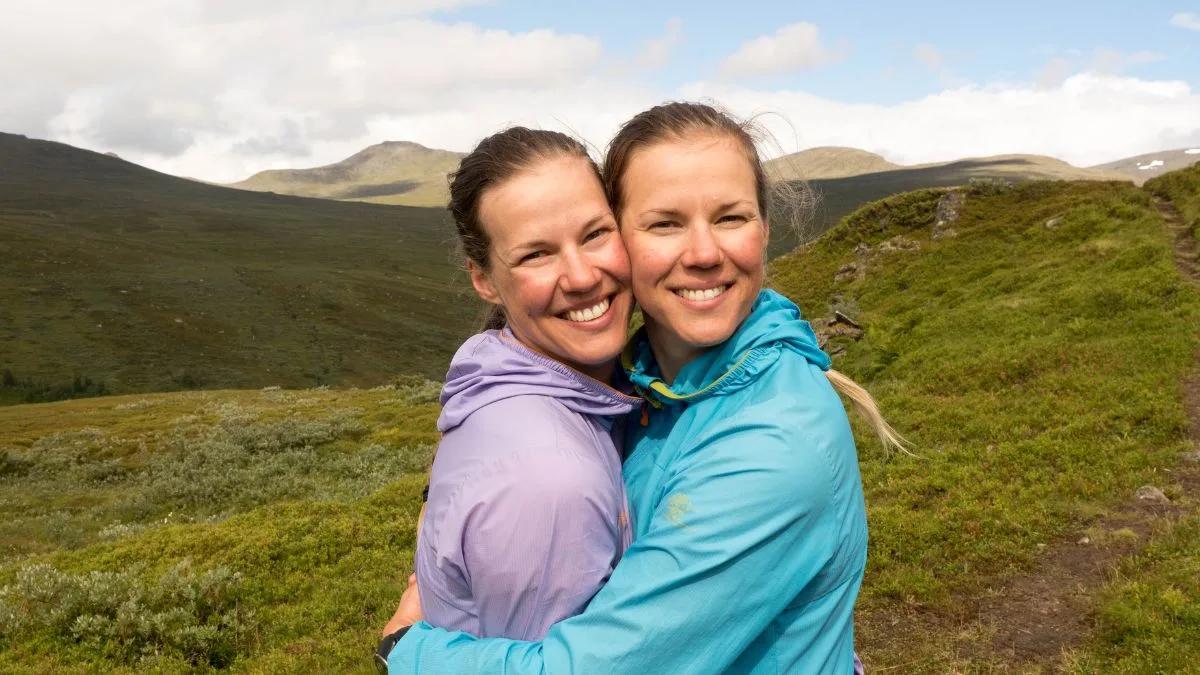
Early April. On day one of the expedition, the thermometer hovered at +6°C as the rain lashed sideways. Slushy snow, heavy pulkas, and stiff, unbroken-in boots set the tone for their 500-kilometre ski trek along Kungsleden. To make matters worse, the sisters share a very particular foot shape, a width equivalent to a size 37 but the length of a size 41, which has always made finding the right footwear a challenge.
Their first destination lay 11 kilometres away, a journey that began with a gruelling climb up the Hemavan ski slopes to reach the Viterskalet cabin. Linnea had cranked her laces tight to secure her boots, but the fit was far from perfect. Soon, a creeping loss of circulation set in, and by the time they reached Viterskalet, she couldn't even bear weight on one foot. Refuelling with a waffle, the sisters gathered themselves and pushed on to the Syter cabin. Day one was in the books. Utterly spent, they fell asleep mid-sentence writing their logs, phones still resting in their hands. The following morning, heels taped, they forged ahead toward Ammarnäs.
By the time they arrived, Linnea's blisters were raw and bleeding, and the fate of the entire expedition felt uncertain. Their friend Åsa Berglund came to the rescue with a replacement pair of boots. At the same time they did a full gear reckoning: their pulkas had read a reassuring 30 kg on a bathroom scale at home, but on proper scales in Ammarnäs they turned out to be carrying close to 50 kg each. They stripped back fifteen kilos apiece, rested a day, and set out again. From that point on, the trail grew better with every kilometre, a trial by fire, but one that taught them lessons they would carry for every mountain kilometre that followed.
Linnea and Erika grew up in Älvsbyn, with roots in Överkalix where their grandparents lived and where they spent large parts of their summers. Their outdoor life as children was not built around expensive gear or ambitious expeditions; it was built around fishing at Jockfall, picking berries in the forest, and grilling sausages over open fire. Their father went out in rubber boots, not hiking shoes, and carried an old frame rucksack. "The focus was never on being far away," Linnea said. "It was on getting outside." Neither of them grew up with adventuring as an identity. They grew up with it as a habit.
Both became physiotherapists. Both played football at elite level for most of their lives: twenty years in total, with ten at the elite level, fitting training and competition around work and studies. The discipline that required had already shaped how they approached hard things: you plan, you put in the hours, and you adapt when things don't go as expected.
The mountain project came from Linnea. In the autumn of 2015, during her adventure guide training, she attended a lecture at the Grövelsjön mountain station about Gröna bandet. The idea took hold immediately. She was supposed to complete a practical placement as part of the course; why not make the placement a thru-hike? She got the approval, called Erika, and as Linnea put it: "I don't think we had to hesitate for long; we generally say yes to anything that aligns with our passions."
They named the project "Fjällets Guldkorn 2000 km" and gave it three phases. First, in March 2016, they would ski Kungsleden from Hemavan to Abisko: almost five hundred kilometres of winter mountain terrain with fully loaded pulkas, over three weeks. Then in summer they would walk Gröna bandet from Treriksröset south to Grövelsjön. And after finishing Gröna bandet, they would drive to Helags and climb it, then continue to the Sylmassivet massif. The goal was to experience the Swedish mountain chain from three perspectives: winter, summer, and summit.
Erika's starting point for all of it was, as she freely admitted, close to zero. When Linnea first showed her how to use a compass, Erika held it upside down. "That probably says quite a lot," Erika said. "A journey this long and demanding is a lot to take on. While I believe that most of us can train our bodies and minds to handle it, it really requires having the right support, time, and conditions in life to make it possible." What she did have was the physiotherapy background, which meant she understood her own body, and the football career, which had taught her what sustained effort actually feels like. And she had Linnea alongside her, which counted for a great deal.
A week before the summer hike began, Linnea stepped on a sharp stone during a rafting exercise and badly damaged her heel. The pain was severe enough that it was unclear whether she could walk at all. She padded and taped the heel, tried extra shoes, and found a way to manage. It hurt on and off in the early stages. But stopping was not seriously considered. Her teacher, Dennis Franzén, gave her some room: "Focus on this hike for now, and we will sort out the school work once you return." Those words lifted a considerable weight.
The other major lesson from the ski tour: eat every hour, at minimum, even when you don't feel hungry. The mountain terrain burns energy in ways that only become clear after it has already taken its toll. "We realized we had to eat and take something in every hour, even if you're not hungry," Erika said. They carried that lesson directly into the summer hike.
Along the way, they played music. Both could play guitar and sing, and they had booked informal performances at mountain stations along the route. They brought just a capo and a guitar pick each; the stations had instruments. They printed chord charts as they went. Those gigs gave structure to the whole journey: on days with a performance booked at a station forty kilometres away, they set out early and kept their pace. "We had a little pressure on us," Linnea said. "But we didn't feel bad about it. It came naturally."
Gröna bandet they completed in 53 days, four ahead of schedule. The mountains offered moments that are hard to put into words: the way the Lappland valleys open out after the narrow gullies of the north, the colours shifting as they moved further south. "There's a curiosity and a desire to discover," Erika said. "You want to see what's around the next corner."
On the ski tour they had met an old man with a white beard who had spent years marking stones along Kungsleden. He had no mobile phone, only a landline at the cabin where he lived. When they arranged to meet him at a lake, he told them he would be there at one o'clock. Asked how he would know the time without a watch, he pointed at the sky. He navigated by the sun. At one o'clock, he was exactly where he said he would be.
The whole project added up to 83 days in the mountains. Coming home was joyful at first, then empty. "You've been living with the project for such a long time," Linnea said. "And then it's over. Nine months, and suddenly it's done." But the emptiness came with something else underneath it: a clearer sense of what matters. "I tend to think I regret the things I haven't done," Linnea said. "If you never try the thing you dreamed of, you don't know if you went and missed out on that dream somehow."
Their advice is simple but hard to shortcut: prepare well, pack light, and get out and practice before you go. The better prepared you are, the more you can enjoy yourself out there. And the lighter your pack, the more you can enjoy every day of it.
Top tips from Linnea & Erika
Linnea and Erika's book, Vandra Gröna Bandet, published in 2020, covers the trek in detail and is aimed at anyone planning a mountain trip, whether a short outing or a long thru-hike, as well as those who simply want to dream of the mountains.